
Montgomery County Criminal Court Cases
Montgomery County criminal court cases do not all begin at the same desk. District Criminal at the Phelps-Price Justice Center hears county misdemeanors and DUI matters outside Montgomery city limits. It also handles the complaint and preliminary stage of a felony. A felony moves to Circuit Criminal after a grand jury returns an indictment. Circuit Criminal also hears misdemeanor appeals from District or Municipal Court. The elected Circuit Clerk keeps both District and Circuit files.
A Montgomery city ordinance, traffic, or qualifying misdemeanor case may remain in Montgomery Municipal Court. Its original file belongs with the municipal clerk unless an appeal or transfer brings it into Circuit Court. This venue split is the first fact to confirm. A county booking, police report, or ALEA history can point toward a case, but none replaces the filed Montgomery County court record.
Montgomery County Court Divisions
The Fifteenth Judicial Circuit organizes Montgomery County court records by division. District Criminal covers county misdemeanors, DUI cases, listed agency violations, and early felony proceedings. Circuit Criminal covers felony cases after indictment. The Circuit Clerk also maintains Traffic, Juvenile, and Warrants divisions, though juvenile access is restricted. The court, charge level, and location of the alleged conduct determine the right counter.
The public counter is in the Phelps-Price Justice Center at 251 South Lawrence Street, Montgomery, Alabama 36104. The clerk's public number is (334) 832-1260, and posted hours are 8:00 a.m. to 5:00 p.m. on weekdays. Visitors should bring the full case number when possible, plus the name, rough filing date, and charge. Court rules bar visitor cell phones and electronic recording devices, so case details should be carried on paper.
Searching Montgomery County Case Records
Alacourt Access, once promoted as Just One Look, is the official statewide trial-court search. It requires an account and payment. A name search or case-number search costs $9.99 and includes one case detail. A name result with more cases can create a separate $9.99 detail charge for each one. Even a no-match name search is billable. Use a known full case number when possible.
- Confirm whether the file began in District, Circuit, or Montgomery Municipal Court.
- Create an Alacourt Access account and choose a name or case-number search.
- Select the criminal record category and enter only the gated fields the service presents.
- Read the action summary in date order, separating charges from the final disposition.
- Ask the proper clerk for missing images, older material, or a certified copy.
| Field or control | Type | Required | Notes |
|---|---|---|---|
| Search type | Choice | Yes | Name Search or Case Number Search |
| Account | Login | Yes | Sign Up or Login before paid search details appear |
| Name criteria | Text | Gated | Exact inner labels are not public before login |
| Case Number | Text | Gated | Use the full Unified Judicial System number |
| Record category | Filter | Unspecified | Choose Criminal from the listed court categories |
The portal does not publish its inner name fields before login, so do not assume it offers a birth-date or county filter. A common name can create several paid detail choices. A full case number is more precise. If the search returns no match, stop before repeating the same paid query. Check spelling, ask which Montgomery County court holds the file, and confirm whether the matter is municipal, restricted, or too old for an online image.
Montgomery County Alacourt Case Access
The official Alacourt Access login page shows the account boundary before any paid Montgomery County case search begins.
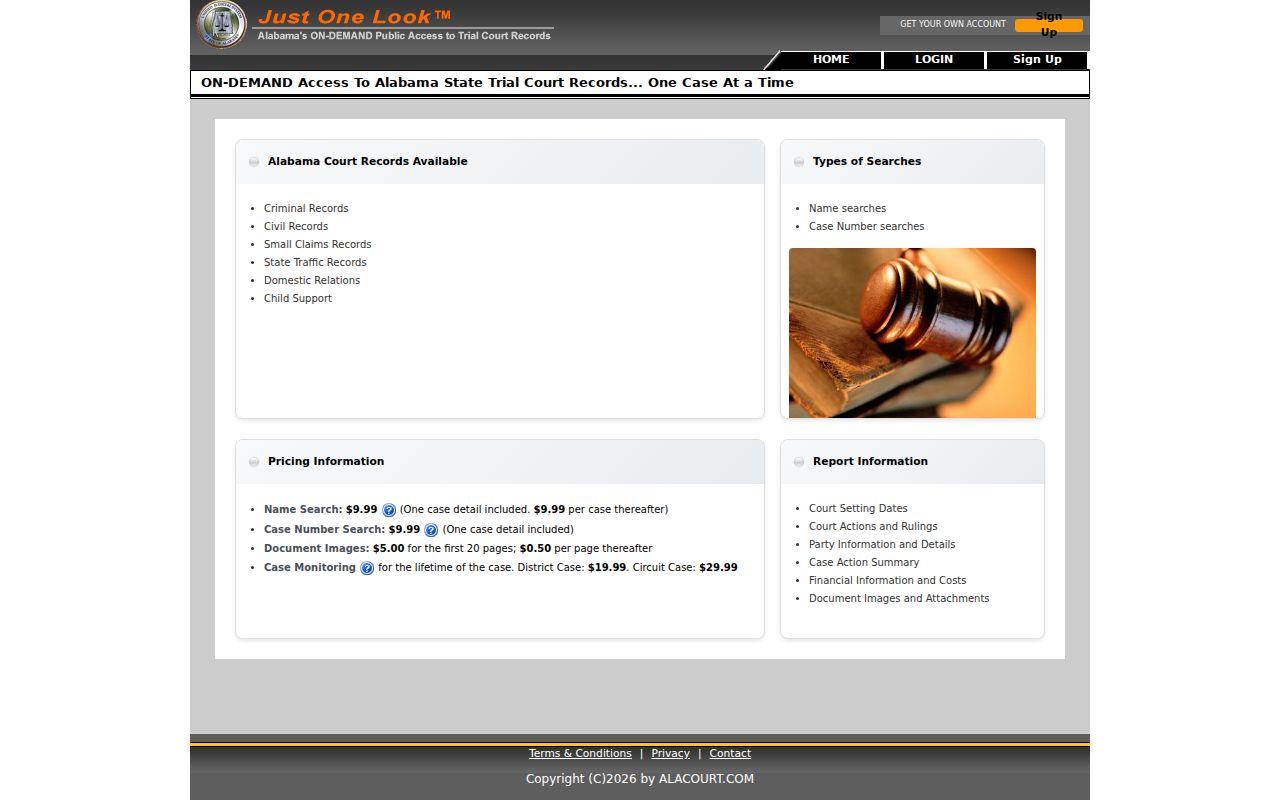
The screen is a gateway, not a free county name index. It confirms why a reader must weigh the paid statewide service against the clerk counter. Alacourt advertises parties, status, setting dates, rulings, detailed case actions, financial history, and available image attachments. Images cost $5 for the first 20 pages and $0.50 for each later page. District case monitoring is $19.99 for life, while Circuit monitoring is $29.99 and emails changes.
When an online image is absent, the official file can be inspected at the clerk counter. In-office electronic viewing is free, though reproduction or certification may cost. A current Montgomery counter fee schedule was not found in the official research, so callers should ask the clerk before ordering. Alacourt.com is a separate monthly read-only subscription and should not be confused with one-case Alacourt Access.
Inside a Montgomery County Case File
A Montgomery County criminal case file records prosecution activity, not merely an arrest. The case action summary is often the best starting point because it places filings, settings, rulings, pleas, and the outcome in time order. A pending status means the matter has not ended. A disposed status means an outcome was entered, but the actual disposition must still be read.
| Case Number and Court | Identifies the division, file, and venue responsible for the proceeding. |
|---|---|
| Charging Document | May be a complaint, warrant, or indictment stating the filed accusation. |
| Docket Entries | Chronological case actions, filed motions, orders, pleas, and rulings. |
| Hearing Dates | Past settings and future court dates recorded by the clerk. |
| Disposition and Judgment | The recorded result, such as dismissal, acquittal, nolle prosequi, or guilt. |
| Sentence and Conditions | Jail, prison, probation, costs, restitution, or other terms ordered after conviction. |
Note: A Montgomery County case status is not itself the outcome; read the judgment or final disposition entry before drawing a conclusion.
Montgomery County Criminal Docket Terms
Short terms on a Montgomery County criminal docket carry distinct meanings. They should not be treated as synonyms. The local court process uses grand-jury and disposition language that can change what the record says without erasing the earlier arrest or charge.
- Bound over
- The felony matter moves from District Court for grand-jury review.
- True bill
- The grand jury returns an indictment based on probable cause, not a finding of guilt.
- No bill
- The grand jury does not return an indictment on the presentation.
- Nolle prosequi
- The prosecutor stops the case, generally subject to lawful refiling.
- Disposition
- The court's recorded outcome for a charge.
An acquittal means not guilty. A dismissal ends that filing, with the record showing whether it was with or without prejudice. A guilty plea or verdict leads to a conviction and later sentence entry. The exact action matters when comparing a court file with an ALEA criminal history.
How a Criminal Case Moves
A Montgomery County felony often starts in District Court with a complaint and initial proceedings. A preliminary hearing may test probable cause. If no hearing is requested, local court guidance says a felony may be bound over after 30 days. A grand jury can then return a true bill, creating an indictment and a Circuit Criminal case. An arraignment follows, with pretrial motions and plea talks before trial or another resolution.
Case flow: Charges Filed › Arraignment › Pretrial › Plea or Trial › Disposition › Sentencing
Each Circuit judge sets an individual docket. Once counsel appears, notices normally go to counsel. The clerk's case actions can show that progress, but scheduling details should be confirmed with the assigned court. A charge can change after prosecutor review or grand-jury action, so the first complaint and final judgment may use different wording.
Montgomery County Court File Gaps
The most common Montgomery County court-record mistake is expecting the clerk file to contain attorney discovery. Circuit Criminal states that discovery is not held as part of the public criminal file and comes through counsel. Police narratives, unfiled evidence, prosecutor work product, victim-service contacts, and secret grand-jury material may also sit outside the clerk's public docket.
If an online case looks incomplete, first verify the court and division. Next, ask whether an older or non-imaged paper file exists. Then request the specific pleading, order, case-action summary, or certified disposition needed. A municipal case must be requested from the Montgomery Municipal Court clerk. For the broader path from booking to filed charges, the Montgomery County arrest lookup explains why an arrest record and a court case can differ.
Case Record Access & Restrictions
Alabama law begins with a resident's right to inspect public writings, but that rule does not open every Montgomery County criminal court record. Ala. Code § 36-12-40 supplies the baseline. Alabama Rule of Judicial Administration 30 bars public release of material made confidential, sealed, exempt, or restricted by law, rule, or court order.
A missing search result can reflect the wrong venue, a spelling issue, a reporting delay, an older file, or a lawful restriction. It does not prove that no proceeding exists. For a proper public record, the clerk may require a written request and prepayment before copies are released. Certification should be requested when the document will be used to correct an ALEA history or support an expungement filing.
Montgomery County Court Diversion
Not every Montgomery County criminal court case follows a straight line from charge to trial. The District Attorney operates a named Pre-Trial Diversion program, and Montgomery County Community Corrections identifies drug court, mental-health court, veterans court, pretrial supervision, electronic monitoring, and other alternatives. Participation is not an automatic outcome. Referral, compliance, completion, or termination may create docket entries that need context.
The District Attorney's diversion program is separate from the Circuit Clerk. Program staff may hold operational records, while filed motions, orders, and dispositions belong in the court file. A missing conviction does not by itself establish that diversion was completed. Confirm the docket and, where appropriate, the program office. The same rule applies to restitution and specialty-court events: read the final disposition before deciding what happened.
Victim-service contacts, prosecutor screening notes, and program assessments may be protected even when a public Montgomery County docket shows a referral or hearing. Ask for a named court entry rather than a broad agency file. That keeps the request tied to material the clerk actually holds and makes any later request for a certified Montgomery County disposition much clearer.