
Sex Offender Checks in Montgomery County
The Alabama Law Enforcement Agency maintains the Alabama Sex Offender Registry through its Criminal Justice Information Services division. It is the main statewide source for a Montgomery County sex offender search. Local law enforcement collects and verifies registration data, a current photograph, and fingerprints, then sends those items to ALEA. ALEA states that the Montgomery County public registry record updates daily in real time from local submissions. That makes the state search the first stop for a name, address, or area check, but it does not replace a call to the Montgomery County registration office when an address or compliance status seems wrong.
Prepare a full name and likely spelling variants before searching. For an area check, use Montgomery County, a city or town, a ZIP code, or the available address-radius mode. Results are conviction-based public registry entries, not a list of every arrest or every sex-related case. The public system also does not make an individualized prediction about future conduct. A careful Montgomery County check matches identifiers, reads the offense and status fields, notes the date context, and verifies concerns through the sheriff rather than drawing a conclusion from one search-result line.
The ALEA registry rules page shows how public coverage works. This official view helps explain why a Montgomery County sex offender search has both useful detail and firm statutory limits.
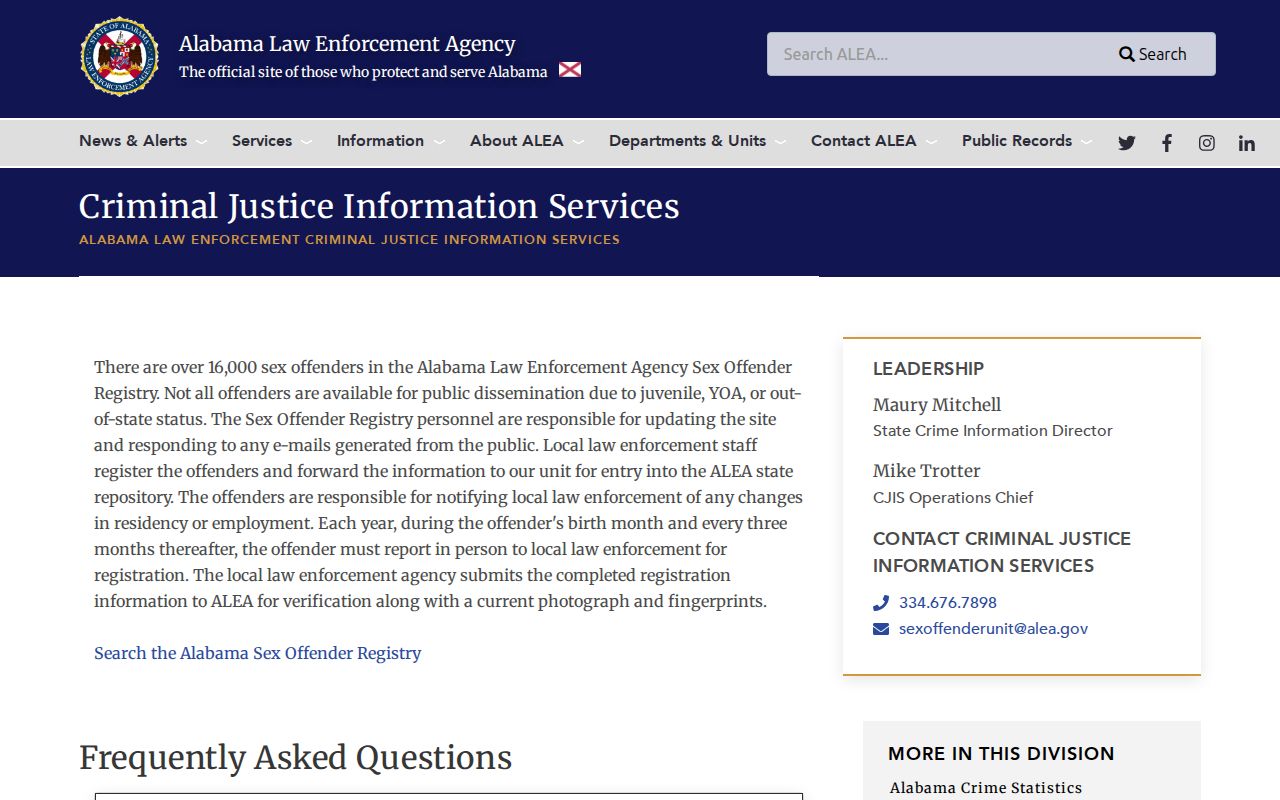
The Montgomery County registry information path is the right source for public-coverage limits, reporting duties, and the proper route for suspected noncompliance.
Montgomery County Registry Office
The Montgomery County Sheriff's Records and Identification Office performs the local registration role. Its public counter is at 100 South Lawrence Street, Montgomery, AL 36104, and the direct number is (334) 832-1387. People who must register should call first to confirm current walk-in or appointment requirements. This is also the correct local office for a resident who believes a listed Montgomery County address is stale or that a reporting duty has not been met. The sheriff verifies local information; ALEA publishes the statewide public entry.
Alabama requires an adult offender covered by the Alabama Sex Offender Registration and Community Notification Act to report in person during the birth month and every three months after that for life. Required changes must also be reported without waiting for the next quarterly visit. Local staff obtain the current photo and fingerprints and pass verified data into the ALEA system. Alabama's official sheriff handbook states that a $10 fee applies to each quarterly appearance and to establishing or ending a residence under Ala. Code §15-20A-22. It may be paid in installments within 90 days.
For Montgomery County registrants, quarterly reporting is an administrative cycle, not a new court judgment. A profile status reflects whether registry duties are recorded as met. It does not erase the need to read the conviction and registration facts in context.
How to Search the Alabama Sex Offender Registry
The ALEA-authorized public registry interface supports both person and place searches. The protected vendor interface did not expose each current control during research, so the table uses capabilities required by Ala. Code §15-20A-8(e). Exact radius choices and button text should be read on the live Montgomery County interface. A sound Montgomery County sex offender search uses the narrowest known facts first, then broadens the place filter when spelling or address details are uncertain.
- For a Montgomery County search, open the official Alabama registry interface and read its conditions and notices before entering a query.
- Search by name, or choose a place mode using Montgomery County, a city or town, ZIP code, or a street address and radius.
- Compare the result list with known identifiers. Check aliases, physical details, and address data instead of relying on a name alone.
- Open the full public profile. Read the qualifying offense, conviction facts, addresses, vehicle fields, and compliance status together.
| Field or mode | Type | Required | Use and limits |
|---|---|---|---|
| Name | Text | Mode-dependent | Try the known legal name and review aliases shown in results. |
| City or Town | Text or list | Mode-dependent | Narrows the Alabama registry to a named municipality. |
| County | List or text | Mode-dependent | Select Montgomery for a county-wide result set. |
| ZIP Code | Text | Mode-dependent | Uses a five-digit geographic filter. |
| Geographic Radius | Address and radius | Mode-dependent | The statute requires radius search capability; confirm the live radius choices. |
| Search and Reset | Buttons | Not applicable | Current vendor labels may read Search and Reset or Clear. |
The Alabama Community Information Center is another official ALEA entry point to public safety tools. Its registry path connects a Montgomery County search to the state source rather than to a private people-search database.
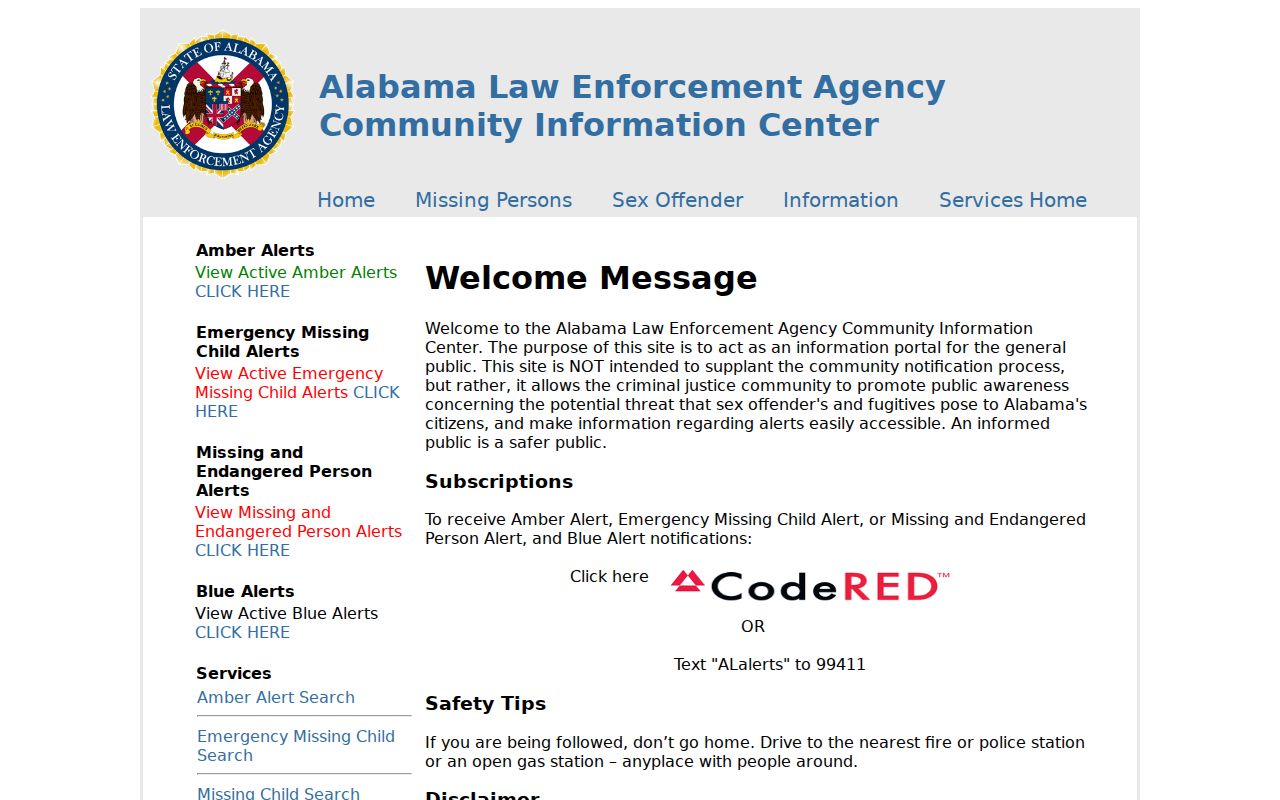
This Montgomery County gateway also separates registry information from fugitive and general alert services, which answer different public-safety questions.
Registry Gaps in Montgomery County
A missing Montgomery County public result does not prove there was no conviction. Alabama law limits which records appear. A first conviction for Indecent Exposure or Sexual Misconduct is not posted. Juveniles generally are not shown unless they received a High Risk adjudication. Youthful offenders generally are not posted unless they were over 18 at the time of the offense. Some federal, military, tribal, or out-of-state convictions may require a due-process determination before public posting.
The Montgomery County public profile also omits specific protected data. Ala. Code §15-20A-8 bars display of non-conviction arrest history, Social Security numbers, travel-document numbers, victim identity, private online identifiers, and internet-provider details. Those limits protect people and keep the public registry focused on the fields the law authorizes. They also mean that a registry search cannot stand in for a Montgomery County court file, an arrest lookup, or a fingerprint-based review of one's own Alabama criminal history.
The official Alabama administrative rule provides a second source for how registry data is maintained and verified.
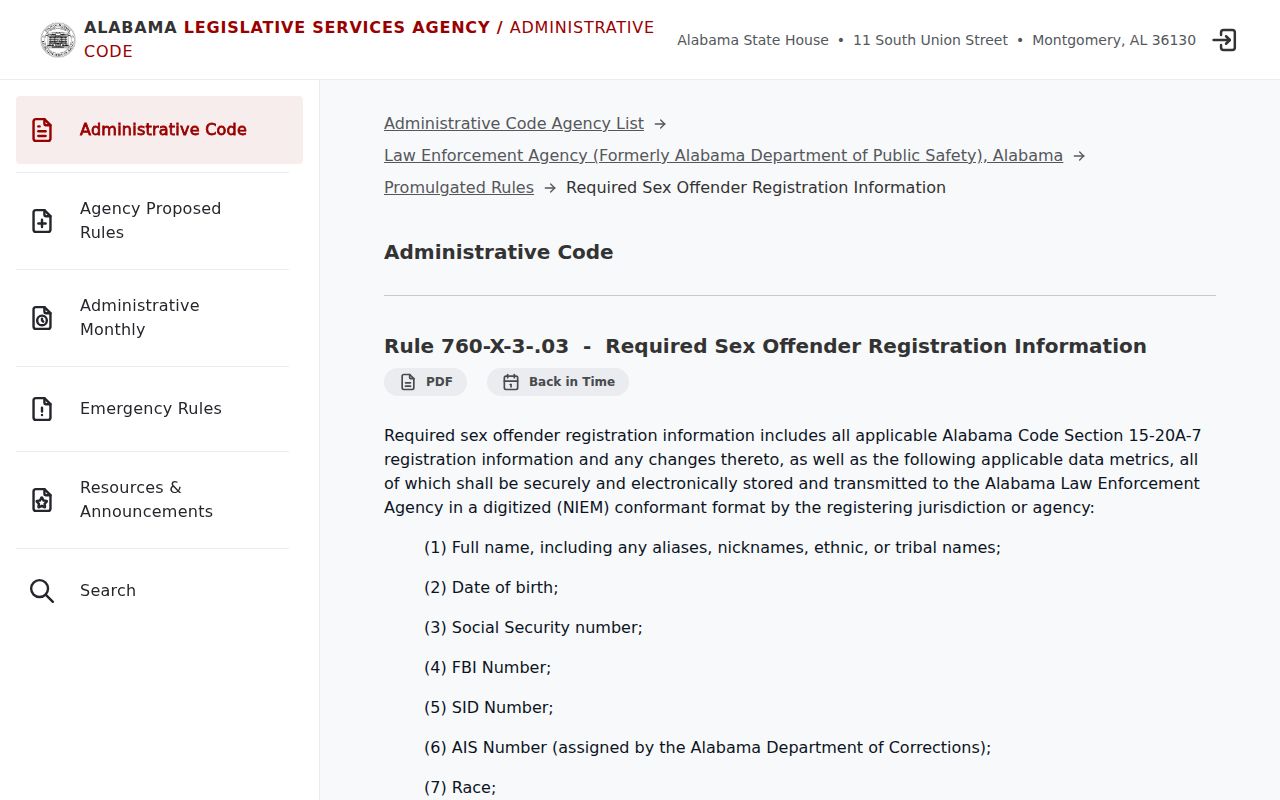
The rule and statute together explain why the internal repository can hold more information than the public Montgomery County registry profile displays.
Inside a Registry Profile
A Montgomery County public profile should be read as a set of linked facts. Identity fields help distinguish people with similar names. Address and vehicle details describe registration data reported to local law enforcement. The conviction fields identify the legal basis for public posting. A compliance label describes an administrative registry status, while incarcerated or absconded labels add custody or reporting context. None of those labels is a stand-alone measure of current risk.
| Name and Aliases | Legal name and known aliases used to compare the right person. |
|---|---|
| Birth and Physical Details | Date of birth, race, sex, hair, eyes, height, weight, photograph, scars, and tattoos. |
| Registered Places | Residence and permitted school or work address information made public by law. |
| Vehicles | Vehicle description, tag, and VIN information listed under statutory fields. |
| Offense Record | Qualifying offense and statute, conviction date and place, court, and case details. |
| Registry Status | Compliant, noncompliant, absconded, or incarcerated status as reported through the registry process. |
Ala. Code §15-20A-8 and Alabama Administrative Code Rule 760-X-3-.03 support this field inventory. The statutory public-fields source shows why each Montgomery County profile is broader than a simple name-and-address card.
Use several identifiers before treating a profile as a match, especially when the name is common or an address has changed.
Montgomery County Registry Versus NSOPW
The Alabama registry and the U.S. Department of Justice's National Sex Offender Public Website serve related but distinct roles. Alabama provides the state-defined profile, public fields, local status, and Montgomery County place filters. NSOPW sends one query across participating states, territories, and tribal jurisdictions. It is useful when a person has lived elsewhere, when the likely state is not known, or when a Montgomery County address search should be checked against a broader history.
NSOPW does not create one national master profile. It federates results from participating public registries, so the source jurisdiction still controls coverage and fields. After a Montgomery County national result points back to Alabama, return to ALEA and local law enforcement for the Alabama record. This avoids treating a summary result as more current than the state that supplied it. The Montgomery County Sheriff app also advertises a nearby-offender feature, but that is a supplement to the statutory ALEA registry, not a replacement for it.
The official NSOPW national search illustrates the wider geographic layer used after an Alabama or Montgomery County search.
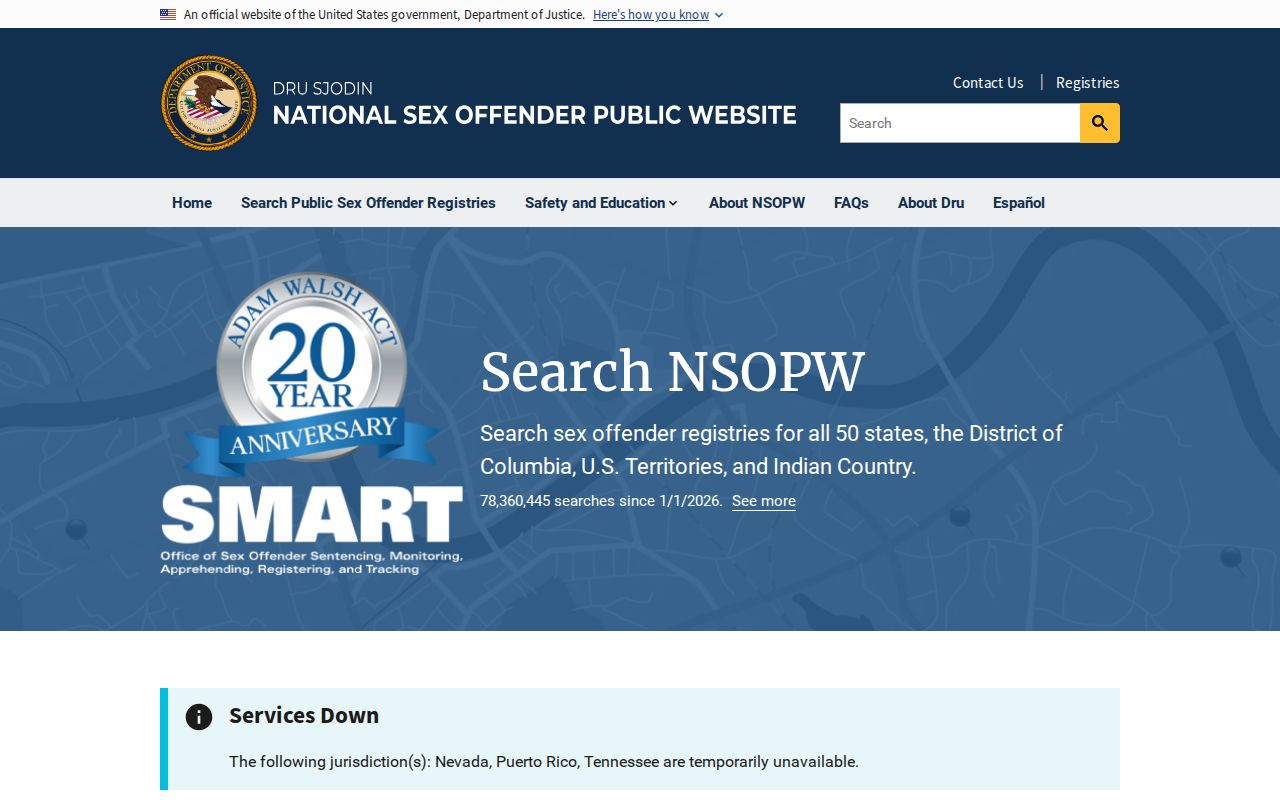
Always follow a national match to its originating registry and compare the live jurisdiction record before relying on the details.
Alabama Registration Levels and Requirements
Alabama does not use federal Tier I, Tier II, and Tier III labels as its reader-facing duration system. Montgomery County adult registration under ASORCNA is generally lifetime reporting, with in-person verification during the birth month and every three months afterward. Juvenile and youthful-offender rules differ, and public visibility is not the same as the length of an internal duty. Applying a federal tier chart to a Montgomery County profile can therefore produce the wrong answer.
| Alabama category | Public visibility | Verification and duration |
|---|---|---|
| Adult covered by ASORCNA | Generally public when the offense and due-process rules are met | Birth-month visit and every three months for life, plus prompt reporting of required changes |
| Juvenile sex offender | Usually not public; High Risk adjudication is an ALEA-stated exception | Court and risk provisions govern rather than adult tier assumptions |
| Youthful offender | Generally not public unless over 18 at the time of the offense | ASORCNA status and applicable orders control |
| Certain outside-jurisdiction cases | Public posting may await an Alabama due-process decision | Alabama duties apply once the person is subject to Alabama law |
Registration duties also include immediate reports of required changes. The table summarizes official public rules, but a court order or case status may affect a particular person.
Montgomery County Registry Address Concerns
When a Montgomery County registry address appears wrong, do not visit the location, confront the listed person, or conduct a personal investigation. Record the exact profile and the address concern, then contact the Montgomery County Sheriff's Records and Identification Office at (334) 832-1387. ALEA expressly directs suspected residence errors and noncompliance to local law enforcement because local staff can compare the report with registration records and forward verified changes.
Montgomery County distance concerns must also be read with care. ALEA states that a person convicted of an offense against a child under 12 cannot loiter on or within 500 feet of listed child-focused places. Residence and proximity restrictions are governed by Ala. Code §§15-20A-10 and 15-20A-11, including exceptions and fact-specific terms. A radius drawn for search convenience is not a legal boundary and should not be used to decide whether an address violates the law.
Note: A stale address may signal noncompliance, a reporting lag, or another issue that only the sheriff and ALEA can verify.
Community Notification and Lawful Use
Online Montgomery County registry access and community notification are related but different systems. A person who moves into Montgomery County may become searchable even when a particular resident did not receive an earlier notice. The registry exists to support awareness and safety planning. It should be used to confirm public facts, guide lawful precautions, and route a suspected violation to the appropriate agency. It is not permission for private enforcement.
Ala. Code §15-20A-8 warns against unlawfully injuring, harassing, or committing a crime against a listed person or anyone at a reported address. Misuse may bring civil or criminal penalties. The safe response is to preserve the registry details and call law enforcement. Emergency threats go to 911; an address or compliance concern goes to the Montgomery County registration office. ALEA's Sex Offender Registry Unit can also be reached at (334) 676-7898 or sexoffenderunit@alea.gov for state-system questions.
Use registry records lawfully. Harassing, threatening, injuring, or committing a crime against a listed person or household can violate Ala. Code §15-20A-8 and lead to civil or criminal penalties.
Montgomery County Registry Status Limits
Three terms must remain separate. A search result means a public entry matched the query. Compliance status reflects reported registration duties. Current risk is a broader safety judgment that the registry does not make for an individual. A compliant label does not promise future conduct, and a noncompliant label does not describe a new conviction. The profile should be read as an official public record with a defined purpose and a specific update chain.
Dates and source offices matter. Local law enforcement verifies and submits Montgomery County information, while ALEA publishes the statewide record. A court supplies the conviction history, and the public registry applies statutory coverage rules. If these sources appear to conflict, use the profile's case and offense details to locate the official court record, then ask the sheriff or ALEA about registry status. For broader county record routing, the Montgomery County criminal history overview explains why court, arrest, custody, and registry files are related but not interchangeable.
Read the full profile, verify the jurisdiction, and use the reporting channel that owns the disputed fact. That approach makes a Montgomery County sex offender search more accurate and safer for everyone involved.